

Why You Should Care About Deep Cleaning Your High-Pile Carpet ?
Did you know that high-pile carpets can hold up to four times more dust, allergens and dust mites than low-pile carpets? If you live in Adelaide, Melbourne or Darwin, seasonal humidity and pollutants make this even more critical for your family’s health.
Many people think daily vacuuming is enough. The truth is, only professional deep cleaning can keep your carpet fibres completely clean, soft and free from allergens. In this guide, you will learn:
-
How to deep clean your high-pile carpet yourself, step by step
-
When you must call a professional
-
The difference between standard and NDIS-approved carpet cleaning in Adelaide, Melbourne and Darwin
Tools You Need Before You Start
Before you begin a deep clean, gather the right tools. Using the wrong equipment can damage your carpet permanently.
| Tool / Method | DIY Option | Professional Option (A Max Clean Group) |
|---|---|---|
| Vacuum cleaner | High-suction cylinder vacuum (minimum 200 air watts) | Industrial HEPA-filtered vacuum |
| Cleaning solution | Mild, pH-neutral carpet shampoo | Enzyme-based, anti-allergen NDIS-approved solution |
| Drying equipment | Fan, open windows, dehumidifier | Professional moisture extraction tools |
| Estimated time | 3–5 hours of work + 12–24 hours drying | 1–2 hours of work + 4–8 hours drying |
Important: If you have never deep cleaned a high-pile carpet before, test any cleaning method on a small hidden area first. Too much moisture can cause permanent odours and mould.
Step-by-Step: How to Deep Clean High-Pile Carpets Like a Professional
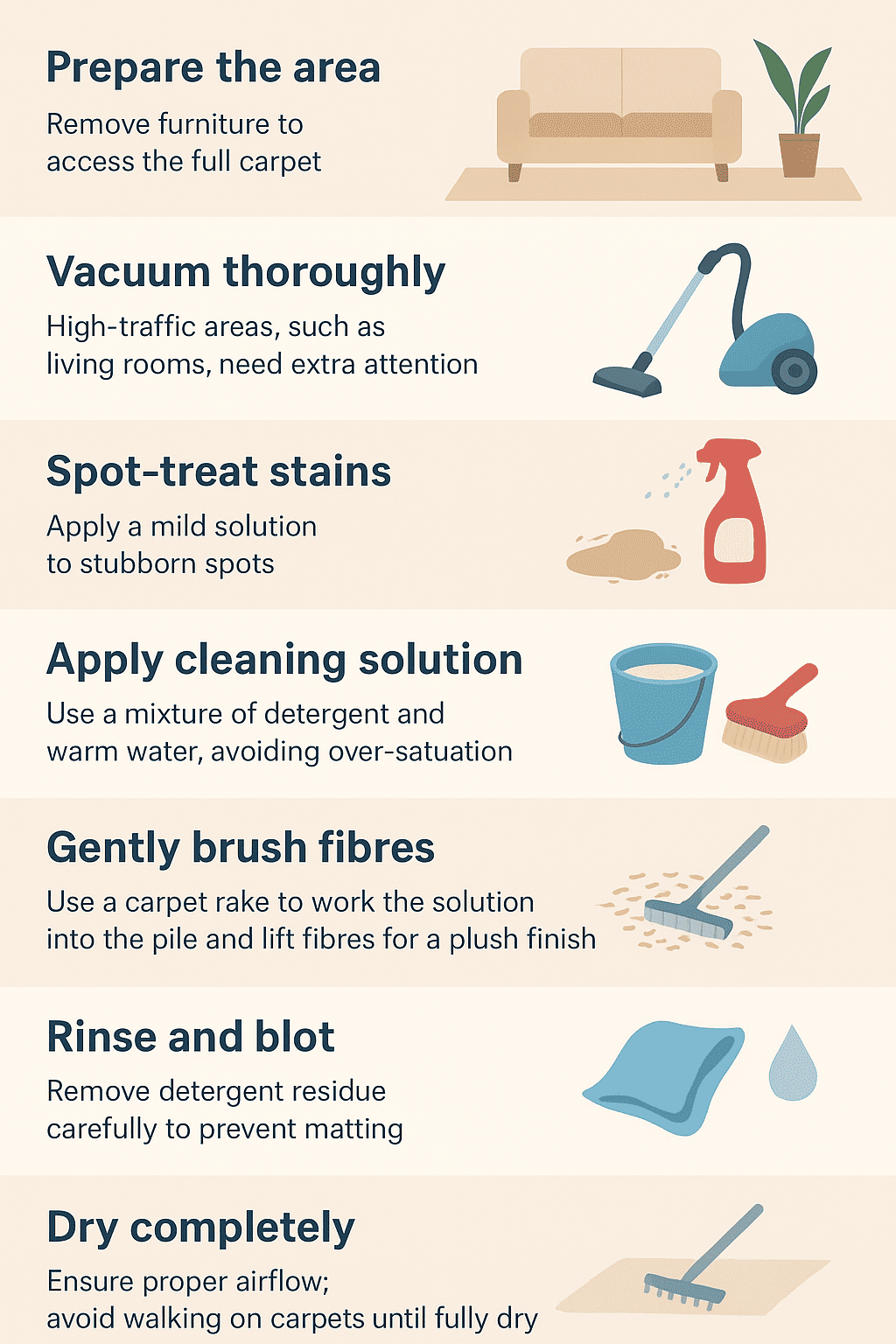
Step 1 – Prepare the area (15 minutes)
Remove all furniture. Do not use plastic furniture cups directly on the carpet – they can leave permanent marks on high-pile fibres.
Step 2 – Vacuum thoroughly (20+ minutes)
Vacuum in two opposite directions. High-traffic areas like living rooms and hallways need at least three passes.
Step 3 – Spot-treat stains (10 minutes)
Use a mild dishwashing liquid mixed with warm water. Never use bleach, bathroom cleaner, or stain removers containing optical brighteners – they will discolour and weaken high-pile fibres.
Step 4 – Apply cleaning solution (30 minutes)
Spray the solution onto the carpet. The golden rule: the carpet should be damp, not soaking wet. Over-wetting is the number one cause of mould and fibre matting.
Step 5 – Gently brush the fibres (10 minutes)
Use a carpet rake or soft-bristled brush. Always brush in the direction of the pile. Brushing against the pile will cause roughness and tangling.
Step 6 – Rinse and blot (20 minutes)
Wipe the surface with a damp microfibre cloth. Then press down with a dry microfibre towel to absorb excess moisture. Do not rub – rubbing spreads residue deep into the fibres.
Step 7 – Dry completely (6 to 24 hours)
Leave air conditioning, fans or dehumidifiers running. Do not walk on the carpet until it is completely dry – not even with socks or slippers.
Common Mistakes to Avoid
| Common Mistake | Short-Term Result | Long-Term Damage |
|---|---|---|
| Using bleach or strong stain removers | Looks clean at first | Fibres become brittle and colour fades |
| Over-wetting the carpet | Seems cleaner temporarily | Mould, musty odours, underlay damage |
| Brushing too aggressively or against the pile | Fibres look separate | Bald patches and rough texture |
| Walking on the carpet before it is fully dry | New dirt sticks immediately | Up to 50% shorter carpet life |
If you live in Adelaide or Melbourne and do not want to take the risk, the A Max Clean Group team eliminates these mistakes for you.
What Exactly Is a High-Pile Carpet Cleaning?
High-pile carpet cleaning goes beyond surface vacuuming. It involves:
Pre-vacuuming to remove surface dirt
Spot treatment for stains
Shampooing or steam cleaning to reach deep fibres
Fibre grooming to restore plushness
Professional services like carpet cleaning Melbourne and NDIS carpet cleaning Melbourne ensure thorough cleaning without damaging delicate fibres.
Why Deep Cleaning High-Pile Carpets Matters?
Deep cleaning is critical for:
Maintaining the carpet’s appearance and softness
Removing allergens, dust mites, and bacteria
Extending the carpet’s lifespan
NDIS participants can benefit from specialised services like NDIS carpet cleaning Adelaide and NDIS carpet cleaning Darwin, ensuring safe, accessible, and effective cleaning.
NDIS Carpet Cleaning Guide for High-Pile Carpets in Australia
If you or a family member is an NDIS participant, deep cleaning your high-pile carpet can be included in your support plan. NDIS-approved cleaning is not just about standard cleaning – it guarantees a safe, hypoallergenic and accessible environment for people with disabilities.
NDIS carpet cleaning services by city:
-
Adelaide – NDIS carpet cleaning Adelaide: perfect for thick carpets in homes and care residences
-
Melbourne – NDIS carpet cleaning Melbourne: faster drying times due to Melbourne’s humid climate
-
Darwin – NDIS carpet cleaning Darwin: focused on moisture removal and mould prevention
How to arrange NDIS carpet cleaning?
Request a service through the free online booking form on the A Max Clean Group website. The support team will coordinate directly with your NDIS plan manager. No out-of-pocket payment is required if the service is approved in your plan.
High-Pile Carpet vs Low-Pile Carpet: Which Is Easier to Clean?
Low-pile carpets trap less dirt and are easier to vacuum. High-pile carpets need proper techniques and tools. However, high-pile carpets offer superior comfort, warmth and sound insulation.
| Feature | High-Pile Carpet | Low-Pile Carpet |
|---|---|---|
| Comfort | Very soft and luxurious | Firm and flat |
| Dirt trapping | High (needs deep cleaning) | Low |
| Cleaning difficulty | Moderate to hard | Easy |
| Best for | Bedrooms, living rooms, NDIS sensory needs | Hallways, offices, high-traffic areas |
Using professional carpet cleaning Adelaide or carpet cleaning Melbourne services helps maintain fibre softness and prevents premature wear regardless of which type you choose.
How Often Should You Deep Clean High-Pile Carpets?
-
High-traffic areas (living rooms, hallways): Every 3–6 months
-
Moderate-traffic areas (bedrooms): Every 6–12 months
-
Low-traffic areas (guest rooms): Once a year
Homes in Adelaide, Melbourne or Darwin with pets, children or NDIS participants will benefit from more frequent professional cleaning.
When Should You Call the A Max Clean Group?
Professional deep cleaning is strongly recommended if:
-
Stains are persistent or have set in for more than a week
-
Your carpet has not been professionally cleaned for over 12 months
-
You or a family member has asthma, allergies or a compromised immune system
-
You want guaranteed results without risking fibre damage
A Max Clean Group provides specialised NDIS carpet cleaning Adelaide, NDIS carpet cleaning Melbourne, and NDIS carpet cleaning Darwin services. We use advanced equipment and techniques designed specifically for high-pile carpets.
Conclusion
Regular deep cleaning, combined with proper daily maintenance and professional support, keeps high-pile carpets soft, clean and long-lasting. Whether you choose carpet cleaning Adelaide, carpet cleaning Melbourne, or NDIS-approved carpet cleaning in Darwin, the goal is the same: a hygienic, comfortable and beautiful carpet for years to come.
For the best results – especially with NDIS requirements or high-humidity climates – trust the professionals at A Max Clean Group. Your carpet will be deeply cleaned, hypoallergenic, and restored to a fresh, like-new condition.
FAQ about Deep Clean Your High-Pile Carpets Like a Pro

How often should I deep clean my high-pile carpet?
High-pile carpets generally need a professional deep clean every 6 to 12 months. Homes with pets, children or high foot traffic may need cleaning every 3 to 6 months to maintain hygiene and extend carpet life.
Can I deep clean a high-pile carpet myself, or should I hire a professional?
You can manage basic cleaning at home – vacuuming and treating light stains. However, a professional service is recommended for proper deep cleaning. Professionals use equipment designed to reach deep into thick fibres without causing matting or moisture damage.
Does steam cleaning damage high-pile carpet fibres?
No – provided the equipment uses controlled temperature. Professional steam cleaners (like those used by A Max Clean Group) keep temperatures below 60°C, which kills bacteria and dust mites while keeping fibres soft and intact.
How long does a high-pile carpet take to dry after deep cleaning?
Drying usually takes between 6 and 24 hours, depending on ventilation and carpet thickness. In Darwin’s humid climate, professional drying equipment reduces this to 4–6 hours.
Is deep carpet cleaning covered by NDIS?
Yes. If carpet cleaning is documented in your NDIS plan as a requirement for maintaining a safe, hygienic and accessible living environment, it can be covered. A Max Clean Group checks your coverage with your NDIS coordinator before any work begins – no surprises.
What is the difference between high-pile and deep-pile carpet?
In British English, “high-pile” and “deep-pile” mean the same thing: carpets with long, loosely twisted fibres that feel soft and luxurious. Both terms are used interchangeably.